
Women Deliver People-Driven Multilateralism
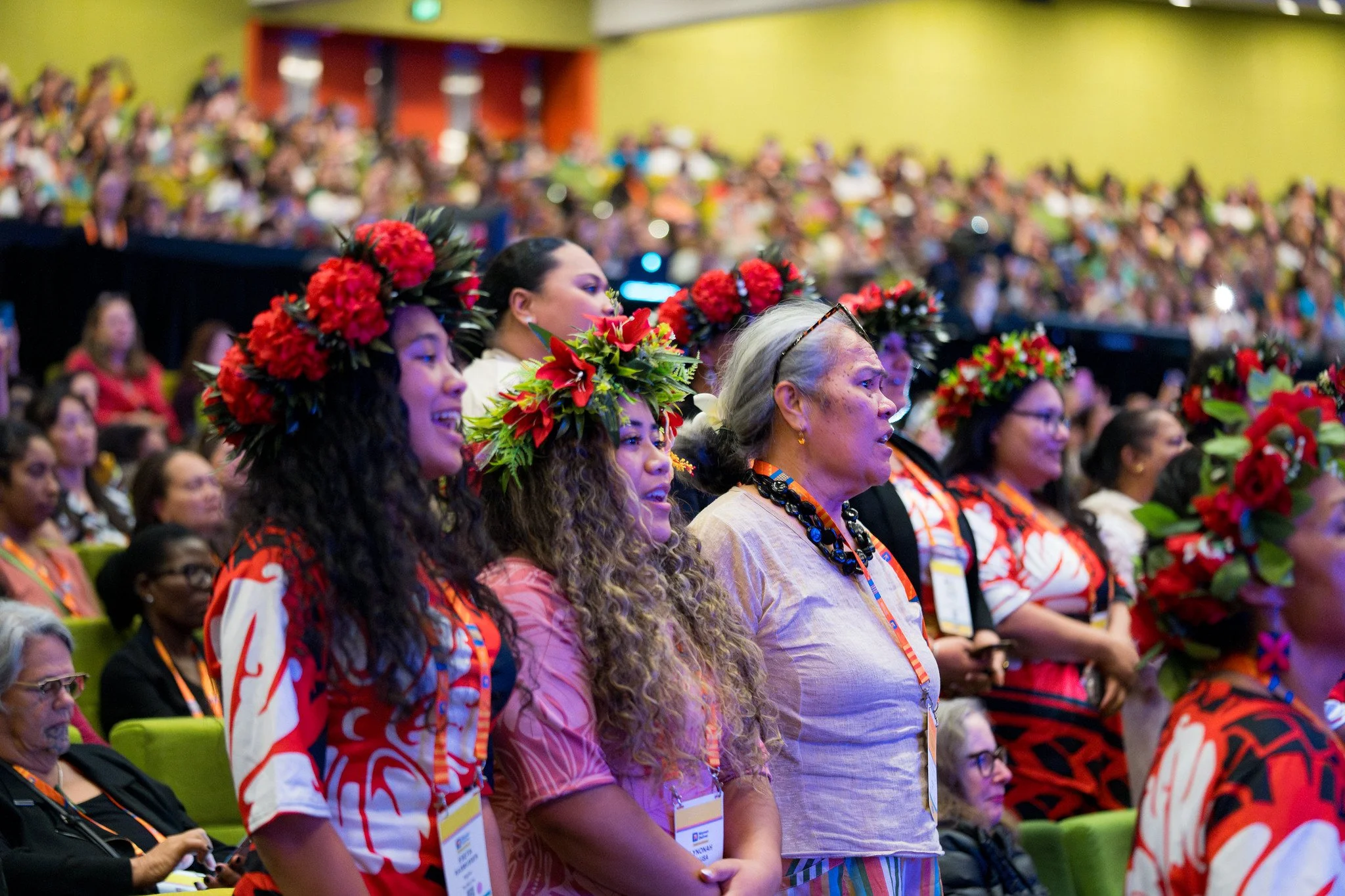
First Nations and Pacific Islander feminists from the Oceanic Pacific region lead proceedings at Women Deliver. Photo: Women Deliver
In April 2026, more than 6,000 women leaders, advocates, and allies from nearly every country in the world came together for the Women Deliver conference in Narrm (Melbourne), Australia. Led by First Nations and Pacific Islander feminists from the Oceanic Pacific region, the conference gathered individuals from across oceans, movements, and generations to share ideas, strengthen movements, and shape a more just and equitable future for all. At the plenary on multilateralism, the United Nations Foundation’s Associate Vice President for Girls and Women Strategy Sia Nowrojee took the stage to share what her experience as a youth delegate at the UN Third World Conference on Women in Nairobi taught her about the power and possibilities of multilateralism, and how sustained advocacy can create transformative change. Sia’s speech from Women Deliver recounts a powerful story of the lessons, memories, and momentum from Nairobi in 1985 and what came next.
Transcript edited for online publication.
Good afternoon. My name is Sia Nowrojee. I am the Associate Vice President for Girls and Women’s Strategy at the United Nations Foundation. Today, 30 years after the landmark World Conference on Women in Beijing, I — along with my team — are the proud stewards of a research project called “Where the Future Was Built,” which focuses on the unique relationship between the global women’s movement and the UN. Our research is anchored to the historic UN World Conferences on Women, beginning in 1975 in Mexico City, 1980 in Copenhagen, 1985 in Nairobi, and 1995 in Beijing, and we link our findings to guide advocacy on gender equality at the UN today. For me, those findings are both professionally informative and deeply personal.
I turned 18 at the NGO Forum of the Third World Conference on Women in Nairobi in 1985. It was a spectacular coming of age.
The Conference brought the global women’s movement to Africa and African girls and women to the movement. It was the largest gathering on gender equality to date, with a third of participants coming from the African continent. There was also strong representation of women from communities of color in the West, from Indigenous and First Nations communities, and from liberation movements.

Welcome signs at the entrance to the NGO Forum in Nairobi in 1985. Photo: Anne S. Walker
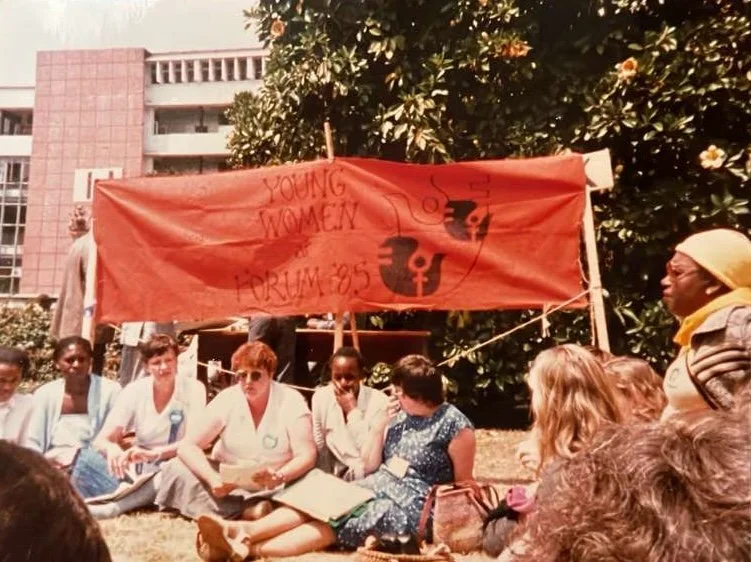
Youth activists at the Nairobi NGO Forum. Photo: Courtesy of Jennifer Klot
I was on a high school delegation of Kenyan girls who wanted more for ourselves and our sisters and somewhere to demand that. The NGO Forum provided that space. I saw my mother, a teacher, advocating for stronger policy on girls’ education. I saw my sister on a delegation of students from women’s colleges advocating for women’s rights. I spent time with Frene Ginwala and Baleka Kgositsile of the African National Congress delegation, who both went on to serve as speakers of independent South Africa’s Parliament. They taught me why the UN was important to a national liberation struggle, and why liberation struggles are important in shaping and holding the UN accountable. I met Egyptian feminist author Nawal al Sadawi and was inspired by her joy and energy, despite the devastating stories she told about the violence that girls and women face. I made friends that I still have today. Mostly, I saw the world of women come to my hometown and tell me that I mattered, we mattered, and we weren’t going to be silent about it.
So, my introduction to multilateralism did not come from a man in a suit (or even in a kanzu). It did not take place in a building in New York or Geneva (or even Addis Ababa). Instead, it was on the lawn of the University of Nairobi, where I sat in a circle with girls my age discussing our rights and the responsibilities our governments have regarding girls and women’s rights. It was in the Peace Tent, where women fundamentally disagreed on issues and yet still built solidarity and a movement. It was in the headlines of my daily newspaper, highlighting global negotiations being chaired by a woman from my country. It was in the interplay of women at the NGO Forum and those at the official conference, cross-pollinating ideas to influence the intergovernmental negotiations. It was in the relentless accountability that the women I met demanded. It was around the kitchen table at my house, as my mother hosted delegates and friends who brought their passion, perspectives, and politics to the conference. It was the friends I made who, even today, sustain me personally, politically, professionally.
Those women, those movements, taught me — and continue to teach me — about the possibilities and the power of multilateralism. And what that first line in the UN Charter really means: We the Peoples.
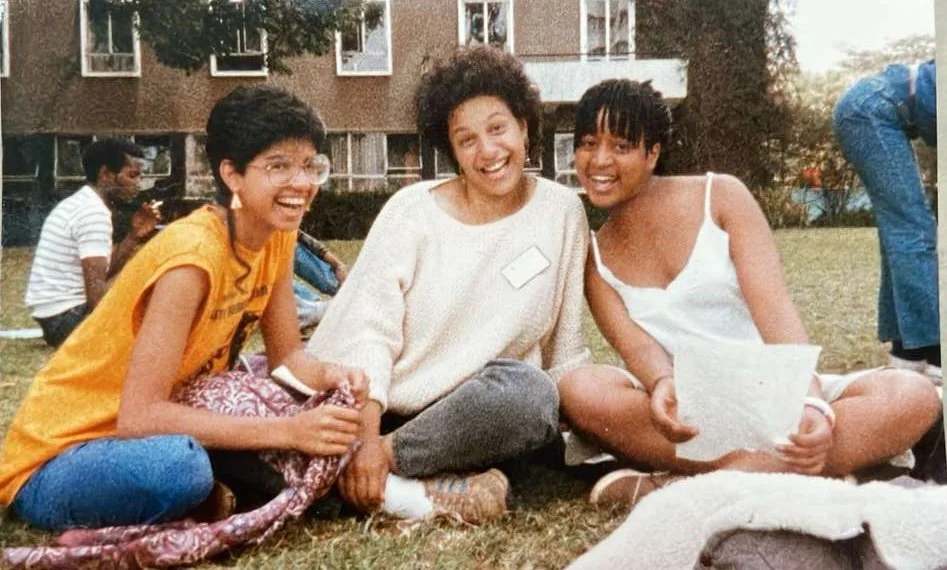
Sia, with other youth activists Jennifer Klot and Lish Echaria at the Nairobi NGO Forum. Photo: Courtesy of Jennifer Klot
Fifty years after women from around the world gathered for the first time in Mexico City, 40 years after I was inspired as a young woman in Nairobi, 30 years after Beijing, we find ourselves here in Narrm (Melbourne), at Women Deliver, in 2026, in a different world. A world that saw transformation within a generation.
Thanks to the advocacy of the global women’s movement at the UN, violence against women is now recognized as a human rights violation; the right to bodily autonomy has replaced demographic statistics as a measure of success on population and development; women’s leadership on war, peace, and security has been identified as crucial to sustainable peace and justice; and girls’ and women’s authority on climate and the environment, particularly that of Indigenous and First Nations girls and women, has been established. A world created by our foremothers, working with allies, to push a complex, imperfect system to serve us better, to be better. A world we could not have imagined when women first gathered in Mexico City in 1975.
But even as this progress was made, those who came before us and many of us today know that multilateral systems were not necessarily built for us. But through our history we also know that those systems are always better when we push them and hold them to account. In the 1960s and 1970s, newly independent states literally changed the face of the UN. The Non-Aligned Movement insisted that colonialism and its impact and the disproportionate influence of so-called “superpowers” be acknowledged and addressed at the UN. From 1975 until today, the global women’s movement has pushed the system to be more representative and responsive to the needs of girls and women, in all our diversity, transforming the international development agenda. Indigenous and First Nations people have ensured that their presence and knowledge is included at decision-making tables. LGBTQI people have fought for their rights and humanity to be recognized globally. Young people have pushed the system and our global community to really listen to them and envision the new world they will create.
We also know that progress through multilateralism is not linear, and we have a long way to go.
H.I.M. Haile Selassie addresses the 1963 UN General Assembly. Video: UN Audiovisual Library
In 1963, Emperor of Ethiopia Haile Sellasie gave a prophetic speech to the UN General Assembly — immortalized in Bob Marley’s anthem “War.” He said: “Until there are no longer any first-class and second-class citizens of any nation, until the color of a man's skin is of no more significance than the color of his eyes, until the basic human rights are equally guaranteed to all, without regard to race – until that day, the dream of lasting peace and world citizenship and the rule of international morality will remain but a fleeting illusion, to be pursued, but never attained.”
Sixty-three years later, we know that that fleeting illusion is exactly what we must continue to fight for. Those values that Haile Sellasie identified so long ago — of peace, global citizenship and belonging, guaranteed human rights for all, regardless of color or nation — are what underpin many of our social justice movements, and are worth fighting for and defending. And they cannot be achieved without sustained advocacy at the grassroots, and national, regional, and global, multinational levels. That is how change is made. That is how change is protected.
Because every step forward triggers a countermovement. This is the reality of fighting for justice, for equality. And today, in this moment, we find ourselves in a world in which the gains we have made are being unraveled in real time. When the contradictions and disappointments of a system that claims to represent all of us, We the Peoples, are keenly on show. It is also a time when anti-rights movements and autocrats denigrate multilateralism, while they skillfully utilize it to advance their agendas. A time when we need to recognize again that the UN is made up of Member States, our States, and that multilateralism actually means us.
We have done it before, and we can do it again.Explore “Where the Future was Built” at Women Deliver.